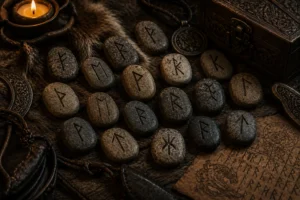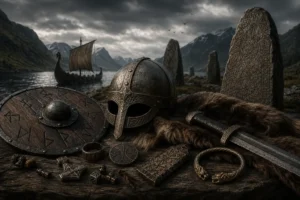

The Elder Futhark is the oldest runic alphabet we know of, and it is the one that started everything. Before the Viking Age brought us the streamlined 16 rune Younger Futhark, before the Anglo-Saxons expanded the system across Britain, there were these 24 symbols. Carved into bone, metal, and stone from roughly 150 CE to 800 CE, the elder futhark runes served as both a functional writing system and a symbolic language rooted in the natural world, the gods, and the forces that shaped daily life in ancient Northern Europe.
If you are new to runes and want to understand them properly, this is where you start. Every modern rune reading practice, every tattoo reference, and every scholarly discussion traces back to these 24 characters.
What Makes the Elder Futhark Special?
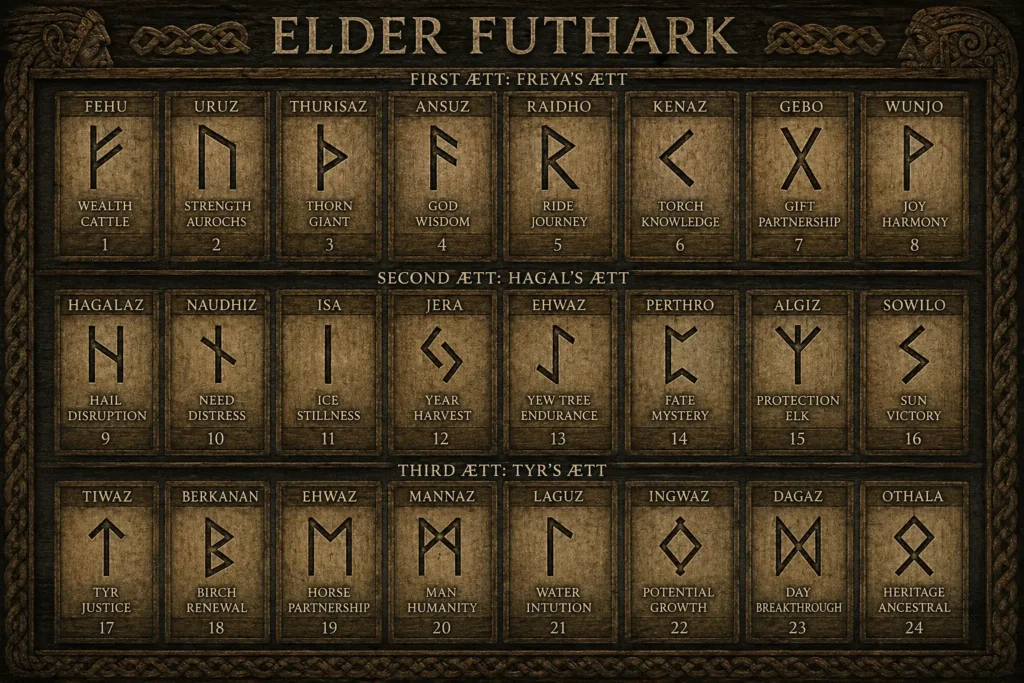
The name “Futhark” works exactly like the word “alphabet.” It comes from the first six runes in the sequence: Fehu, Uruz, Thurisaz, Ansuz, Raidho, and Kenaz. The system contains 24 runes, divided into three groups of eight called ættir (singular ætt), an Old Norse word meaning “clans” or “families.”
The earliest confirmed carving of all 24 futhark runes in their proper order appears on the Kylver Stone, a limestone slab discovered in 1903 during an excavation on the island of Gotland, Sweden. The stone dates to approximately 400 CE and was found used as a grave cover, with the inscription carved on the underside. It is currently held by the Swedish History Museum in Stockholm.
What makes the Kylver Stone especially significant is that vertical marks on its surface separate the three ættir, confirming that the threefold division is not a modern interpretation. The people who used these runes 1,600 years ago already organised them into three distinct groups.
Knowledge of how to read the elder futhark runes was eventually lost as the system gave way to the Younger Futhark in Scandinavia. It was not deciphered again until 1865, when Norwegian scholar Sophus Bugge cracked the code. Everything we know about reading these runes today flows from that breakthrough.
How We Know What Each Rune Means
There is no surviving Elder Futhark rune poem. The three medieval rune poems that do exist, the Icelandic, the Norwegian, and the Anglo-Saxon, are based on the later Younger Futhark and Anglo-Saxon Futhorc systems. However, scholars have reconstructed the Elder Futhark rune names and meanings by working backwards from these poems, from Gothic alphabet records, and from the archaeological contexts where the runes appear.
The meanings listed below are the widely accepted scholarly reconstructions. They are grounded in historical evidence, not guesswork.
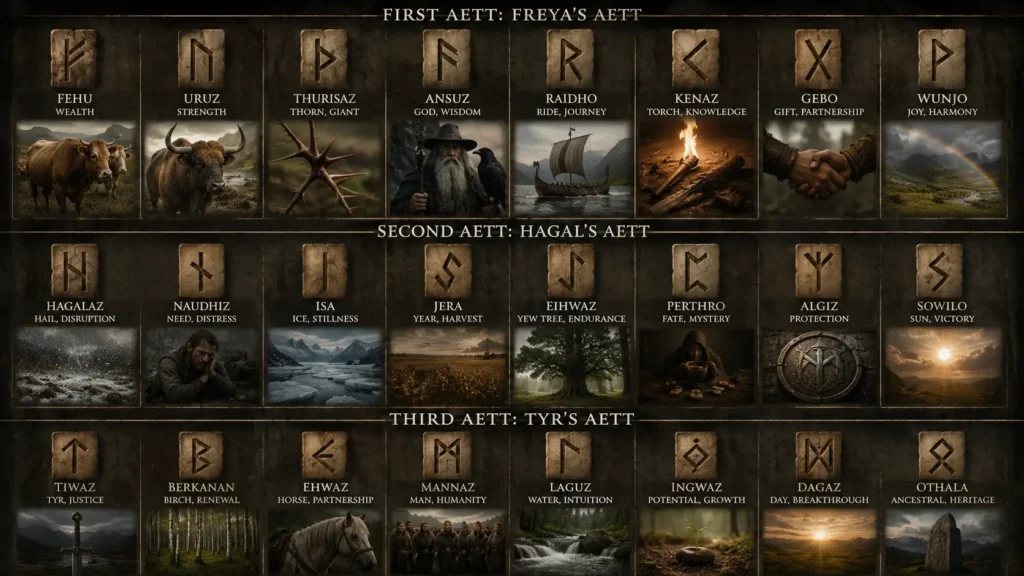
First Ætt: Freya’s Ætt
This group deals with the material world, creation, strength, and the forces that drive human life forward.
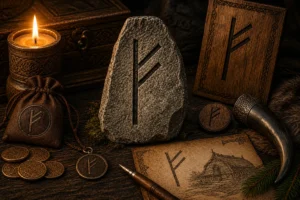
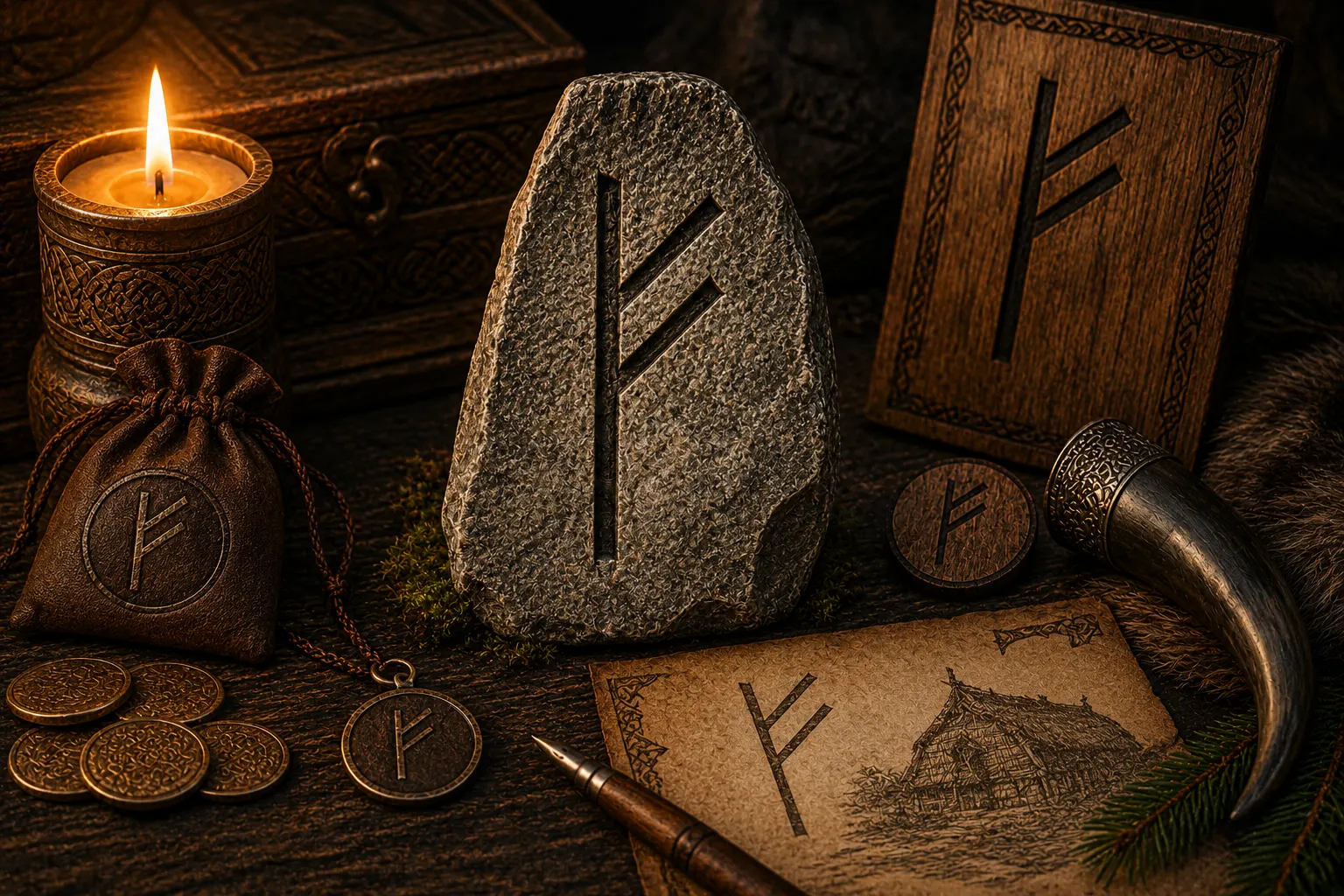
Fehu (ᚠ) means “cattle” or “wealth.” In a world where livestock equalled currency, Fehu represented prosperity, abundance, and the responsibility that comes with having resources. It is the first rune of the entire futhark for a reason. Everything begins with sustenance.
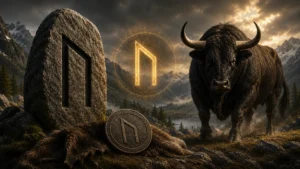
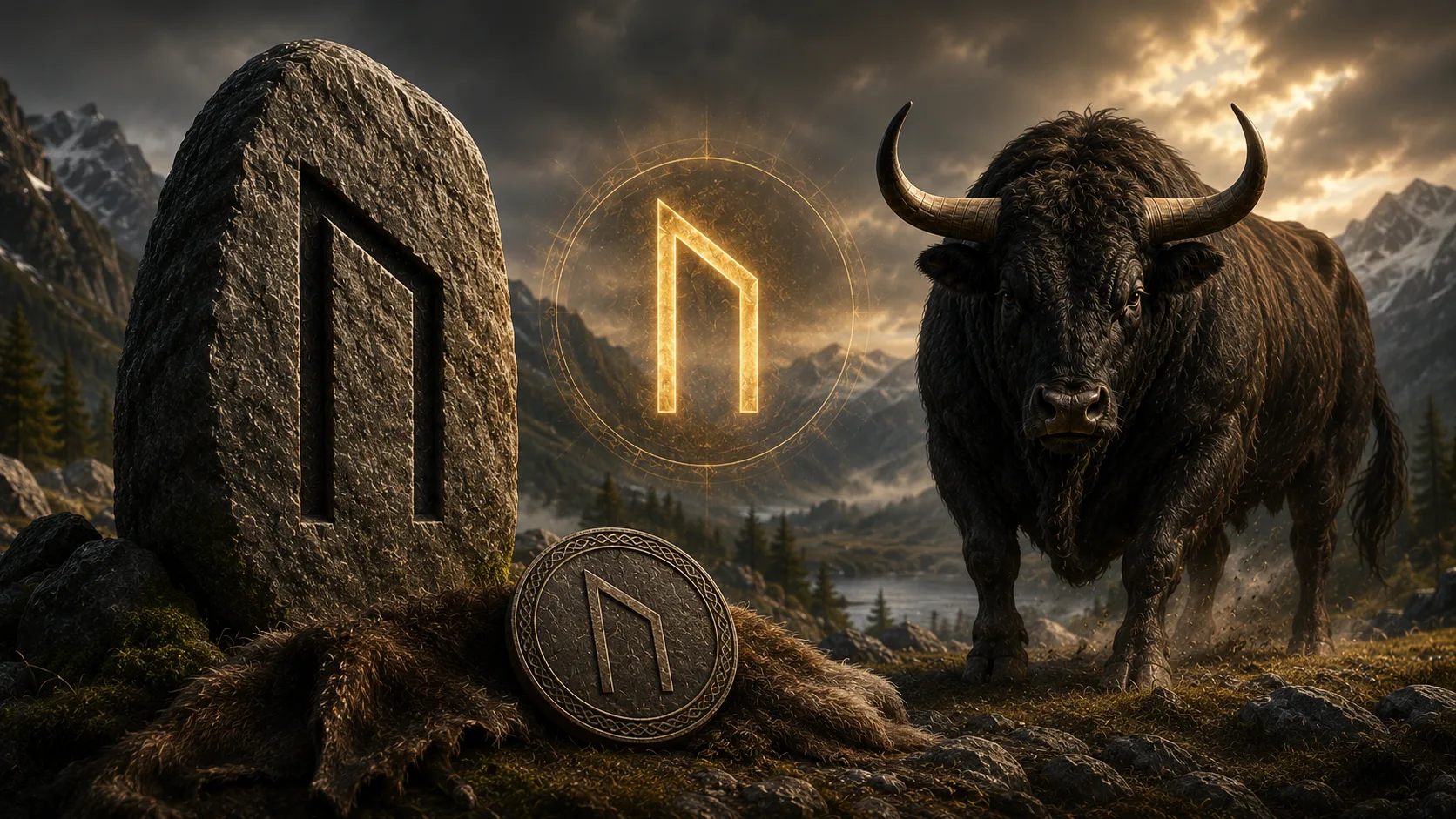
Uruz (ᚢ) means “aurochs,” the now extinct wild ox that roamed Northern Europe. It symbolises raw, untamed physical strength, vitality, and primal endurance. Where Fehu is wealth made useful, Uruz is power in its natural state.
Thurisaz (ᚦ) means “giant” or “thorn.” It connects to the jötnar, the giants of Norse mythology, and represents reactive force, conflict, and the kind of danger that also serves as protection. A thorn defends the rose.
Ansuz (ᚨ) means “god,” specifically Odin in most interpretations. It represents divine breath, wisdom, communication, and inspiration. This is the rune of speech, poetry, and the spoken word as a creative force.
Raidho (ᚱ) means “ride” or “journey.” It encompasses both physical travel and the idea of life as a path. For cultures that moved constantly, by ship, by horse, and on foot, the journey was not a metaphor. It was daily reality.
Kenaz (ᚲ) means “torch.” It represents controlled fire, illumination, knowledge, and the craft of making things. If Uruz is raw power, Kenaz is that power directed by human skill and intelligence.
Gebo (ᚷ) means “gift.” It symbolises generosity, exchange, partnership, and the sacred bonds created through giving and receiving. In Norse culture, gift-giving was a serious social contract, not a casual gesture.
Wunjo (ᚹ) means “joy.” It represents happiness, harmony, and the fulfilment that comes when things align. It closes the first ætt on a high note, marking the completion of the material foundation of life.
Second Ætt: Hagal’s Ætt
This group shifts into harder territory. It covers disruption, endurance, and the forces of nature and fate that humans cannot control.
Hagalaz (ᚺ) means “hail.” Hailstorms destroy crops, damage shelters, and arrive without warning. This rune represents sudden disruption, uncontrollable change, and the events that force you to rebuild.
Naudhiz (ᚾ) means “need” or “distress.” It points to hardship, constraint, and necessity. But it also carries the idea that need is the mother of invention. Pressure creates action.
Isa (ᛁ) means “ice.” It symbolises stillness, stagnation, and the frozen pause that can be either a period of rest or a dangerous trap. In Scandinavian winters, ice was not poetic. It was survival.
Jera (ᛃ) means “year” or “harvest.” It represents the natural cycle of seasons, the reward that comes from patient work, and the understanding that everything has its time. You cannot rush a harvest.
Eihwaz (ᛇ) means “yew tree.” The yew is evergreen, resilient, and long lived, but also poisonous. This rune represents endurance, transformation, and the connection between life and death. Yew wood was used to make bows, tying it to both survival and warfare.
Perthro (ᛈ) is one of the most debated runes. Its meaning is uncertain, but most scholars associate it with chance, fate, or a cup used for casting lots. It may represent the unknown, the hidden, and the element of luck in human affairs.
Algiz (ᛉ) means “elk” or “protection.” Its shape resembles outstretched hands or the spreading antlers of an elk. It is widely regarded as one of the most powerful protective symbols in the elder futhark runes and appears frequently on amulets and shields.
Sowilo (ᛊ) means “sun.” In lands where winter darkness lasted months, the sun was not just warmth. It was victory, hope, health, and life force itself. Sowilo closes the second ætt with light after a long stretch of hardship.
Third Ætt: Tyr’s Ætt
The final group addresses honour, legacy, human relationships, and the passage from this world to whatever comes next.
Tiwaz (ᛏ) is named after Tyr, the Norse god who sacrificed his hand to bind the great wolf Fenrir. It represents justice, honour, self-sacrifice, and leadership. This rune is about doing what is right even when it costs you something.
Berkanan (ᛒ) means “birch.” The birch tree is one of the first to grow back after winter, making it a symbol of new beginnings, renewal, fertility, and the quiet strength of growth.
Ehwaz (ᛖ) means “horse.” It symbolises partnership, trust, and the cooperative relationship between horse and rider. By extension, it represents all partnerships built on mutual respect and teamwork.
Mannaz (ᛗ) means “man” or “human.” It represents humanity, self-awareness, community, and the social structures that bind people together. This rune points inward as much as outward.
Laguz (ᛚ) means “water” or “lake.” It symbolises flow, intuition, the unconscious mind, and the vast, unpredictable power of the sea. For a culture that built some of the finest ships in human history, water was both livelihood and danger.
Ingwaz (ᛜ) is named after the god Ing (Freyr). It represents internal growth, potential energy, gestation, and the quiet period before something is ready to emerge. Think of a seed beneath frozen ground in late winter.
Dagaz (ᛞ) means “day” or “dawn.” It represents breakthrough, awakening, clarity, and the decisive moment when darkness turns to light. It is transformation in its most hopeful form.
Othala (ᛟ) means “ancestral property” or “homeland.” It represents inheritance, belonging, tradition, and everything that connects you to where you came from. As the final rune of the Elder Futhark, it closes the cycle with a return to one’s roots.
Why the Elder Futhark Still Matters
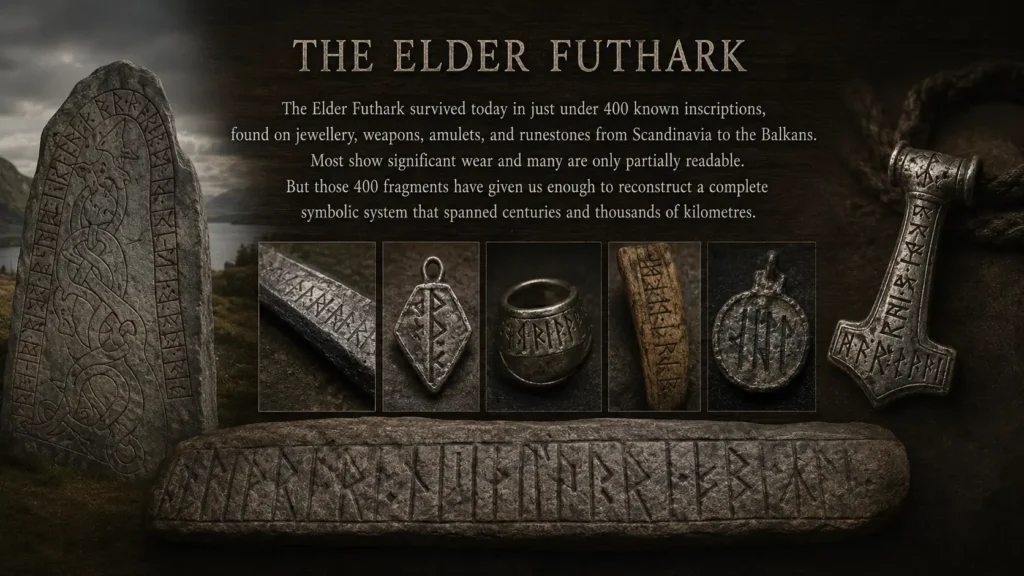
The Elder Futhark survived today in just under 400 known inscriptions, found on jewellery, weapons, amulets, and runestones from Scandinavia to the Balkans. Most show significant wear and many are only partially readable. But those 400 fragments have given us enough to reconstruct a complete symbolic system that spanned centuries and thousands of kilometres.
It is also the system most commonly used in modern rune reading and divination. When someone pulls a rune from a pouch or casts a set of stones, they are almost always working with elder futhark runes. The 24 symbol set offers more nuance and range than the 16 rune Younger Futhark, which is one reason it remains the standard for spiritual practice.
Whether your interest is historical, linguistic, or personal, these 24 symbols are the foundation of everything in the runic world. Every system that came after, the Younger Futhark of the Vikings, the Anglo-Saxon Futhorc, the medieval runes of later Scandinavia, all trace their roots back here.
What to Explore Next
Each of these 24 runes has layers of meaning, mythology, and historical context that go far beyond a single guide. If you want to understand how these symbols were used in practice, our guide to Norse runes and their history covers the cultural context in depth. And if you are just starting your journey into the runic world, our complete beginner’s guide to runes will give you the broader picture of how all three major runic systems connect.