
You are probably looking at your phone right now with a bind rune on it. Not carved into it, of course, but displayed on it. The Bluetooth logo that sits in your settings menu is a bind rune. It merges two Younger Futhark runes, ᚼ (Hagall, representing H) and ᛒ (Berkanan, representing B), into a single combined symbol. Those are the initials of Harald Bluetooth, the 10th century Danish king who unified Scandinavia, and the technology was named after him because it aimed to unify communication protocols.
That is a bind rune in its simplest form. Two runes, merged into one glyph, carrying a combined meaning. The concept has been around for nearly two thousand years, and it is still being used today, both by billion-dollar tech companies and by individuals crafting personal symbols for protection, focus, or intention.
What Exactly Is a Bind Rune?
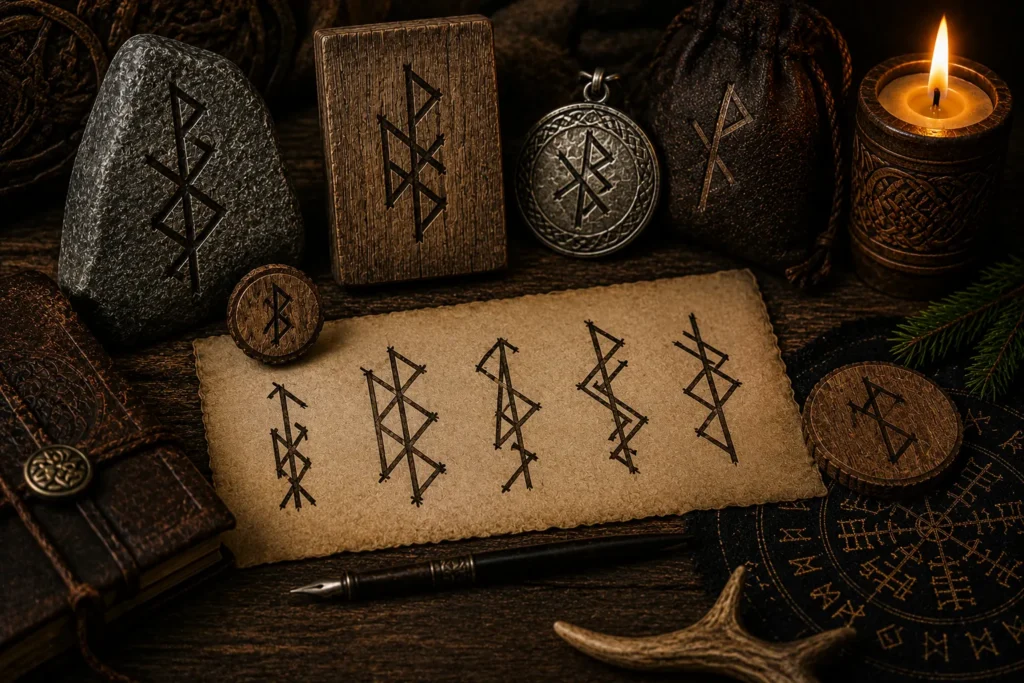
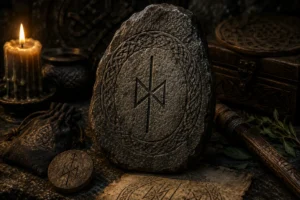
A bind rune (Old Icelandic: bandrún) is a ligature of two or more runes combined into a single visual symbol. Instead of writing runes side by side, the carver merges them, usually by sharing a common vertical stroke. The result is one glyph that carries the phonetic or symbolic weight of all the runes it contains.
Think of it like a monogram. When you see a monogram on a piece of luggage or stationery, two or three letters are woven together into one design. Bind runes work on the same principle, except that each component rune brings not just a letter but an entire concept with it.
According to the runological research of Klaus Düwel, bind runes appear in runic inscriptions from the earliest periods of runic writing. They were used to compress names, highlight significant words, serve as maker’s marks, and possibly invoke symbolic or magical power. The individual rune meanings do not disappear when runes are bound together. They combine, creating something that carries the weight of all its parts simultaneously.
The Two Types of Bind Runes
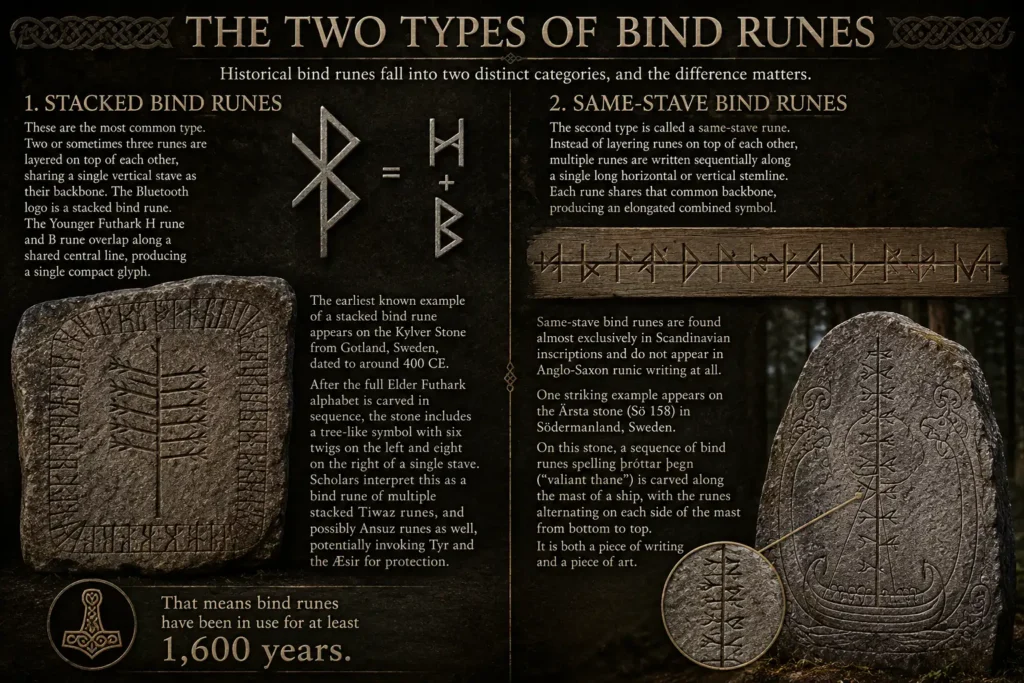
Historical bind runes fall into two distinct categories, and the difference matters.
Stacked Bind Runes
These are the most common type. Two or sometimes three runes are layered on top of each other, sharing a single vertical stave as their backbone. The Bluetooth logo is a stacked bind rune. The Younger Futhark H rune and B rune overlap along a shared central line, producing a single compact glyph.
The earliest known example of a stacked bind rune appears on the Kylver Stone from Gotland, Sweden, dated to around 400 CE. After the full Elder Futhark alphabet is carved in sequence, the stone includes a tree-like symbol with six twigs on the left and eight on the right of a single stave. Scholars interpret this as a bind rune of multiple stacked Tiwaz runes, and possibly Ansuz runes as well, potentially invoking Tyr and the Æsir for protection.
That means bind runes have been in use for at least 1,600 years.
Same-Stave Bind Runes
The second type is called a same-stave rune. Instead of layering runes on top of each other, multiple runes are written sequentially along a single long horizontal or vertical stemline. Each rune shares that common backbone, producing an elongated combined symbol.
Same-stave bind runes are found almost exclusively in Scandinavian inscriptions and do not appear in Anglo-Saxon runic writing at all. One striking example appears on the Ärsta stone (Sö 158) in Södermanland, Sweden. On this stone, a sequence of bind runes spelling þróttar þegn (“valiant thane”) is carved along the mast of a ship, with the runes alternating on each side of the mast from bottom to top. It is both a piece of writing and a piece of art.
Were Bind Runes Magical?
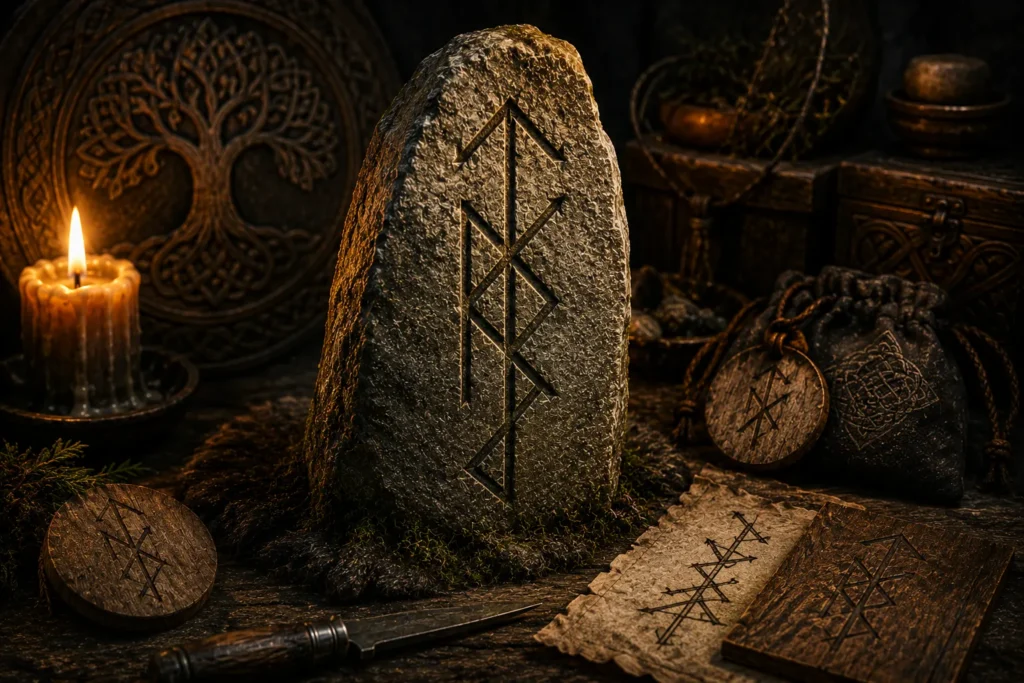
This is where you need to be honest about what we know and what we are guessing.
The historical evidence for bind runes is primarily practical. Most documented examples in archaeological contexts are ligatures used to compress names, save space on limited surfaces like jewellery and weapons, or add decorative flair to inscriptions. The Järsberg Runestone from Sweden, dated to the early 6th century, contains four bind runes that are clearly functional text ligatures, combining letters like “h+a” to save space.
On some runestones, bind runes appear to have been ornamental, used to highlight the name of the carver or the person being commemorated. Wikipedia’s entry on bind runes notes that they were “extremely rare in Viking Age inscriptions, but are common in earlier (Proto-Norse) and later (medieval) inscriptions.”
However, there are examples that hint at something beyond the practical. The Kylver Stone’s stacked Tiwaz bind rune, placed after the complete futhark sequence on the inside of a grave cover, is difficult to explain as purely decorative. One runic inscription from the archaeological record features the repeated sequence “Ga Ga Ga,” a bind rune combining Gebo and Ansuz, found on both an amulet and a spear shaft. Whether this was a magical chant, a battle cry, or something else entirely remains genuinely unknown.
The honest answer is that bind runes likely served multiple purposes across different periods. Some were shorthand. Some were art. And some may well have carried intentional symbolic or magical weight. The Norse did not draw a hard line between the practical and the sacred the way modern cultures tend to.
Bind Runes in Modern Practice
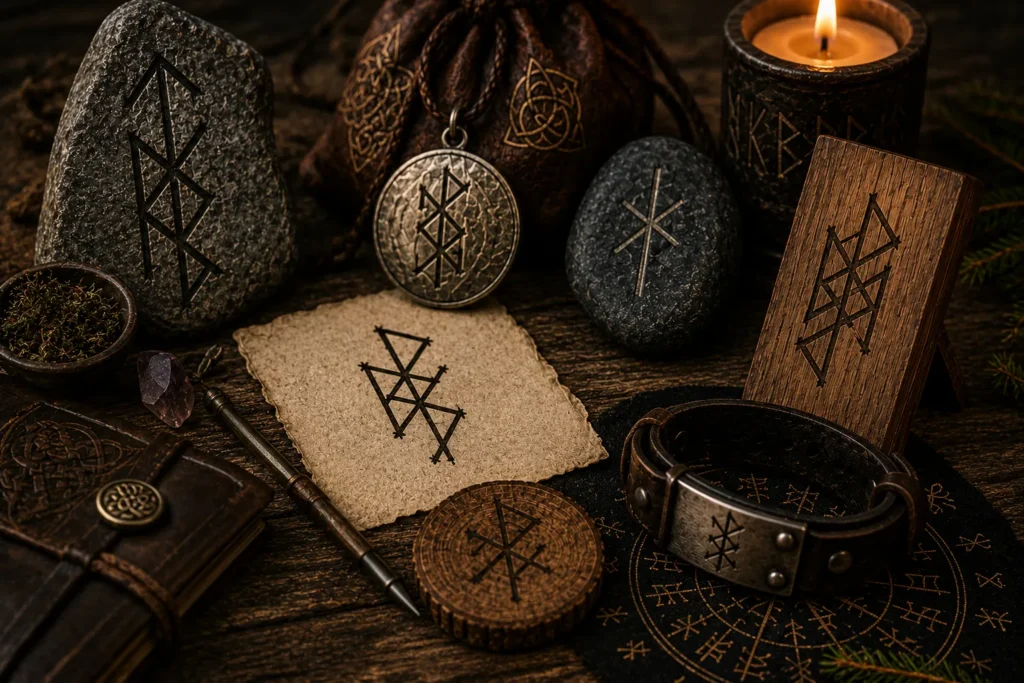
Today, bind runes have experienced a major revival. Modern practitioners create custom bind runes by combining Elder Futhark runes whose meanings align with a specific intention. Someone seeking courage and protection might bind Tiwaz (honour, justice) with Algiz (protection) and Sowilo (victory, vitality). The resulting symbol becomes a personal talisman, carried as jewellery, drawn on paper, or tattooed onto skin.
It is important to acknowledge that this modern practice draws more from 20th and 21st century spiritual traditions than from documented Viking Age behaviour. Historical bind runes were primarily textual ligatures, not personalised intention sigils. But the modern practice is not random or baseless either. It builds on the well-established historical fact that individual runes carried symbolic meanings, and it extends the logical principle that combining runes combines their symbolic force.
Whether you approach bind runes from a historical, spiritual, or creative perspective, the method of creating them is the same.
How to Create Your Own Bind Rune
Making a bind rune is straightforward in principle but requires thoughtful attention in practice. Here is a step-by-step approach.
Step 1: Define Your Intention Clearly
Before you touch pen to paper, get specific about what you want the bind rune to represent. “Protection” is vague. “Protection during a period of major change” is specific. The clearer your intention, the better your rune selection will be.
Step 2: Choose Your Runes
Select two or three runes whose meanings align with your intention. Using more than three runes tends to create visual clutter and dilutes the focus. Less is more with bind runes.
For example, if your intention is strength through a difficult transition, you might choose Uruz (ᚢ) for raw strength, Raidho (ᚱ) for the journey, and Jera (ᛃ) for patience and eventual reward.
If you are not yet confident in rune meanings, take the time to study each one individually before building combinations. A bind rune built on misunderstood components is just a random drawing.
Step 3: Sketch the Combination
Start with the rune that has the strongest vertical stroke and use it as your shared stave. Then overlay the other runes onto it, adjusting their positions so that the combined symbol is balanced and readable. The goal is a single glyph where each component rune is still recognisable but the whole design feels unified.
There is no single correct way to combine runes visually. Historical bind runes varied enormously in design, and modern practitioners have the same creative freedom. What matters is that the runes are all present and the symbol feels coherent to you.
Step 4: Refine and Simplify
Look at your sketch. If it feels cluttered or confusing, simplify. Remove any lines that duplicate each other. Make sure no unintended runes have appeared in the overlap, because when you merge angular shapes, new letter forms can accidentally emerge. Some practitioners specifically check for this and adjust their design to avoid including rune meanings they did not intend.
Step 5: Set Your Intention
Once your bind rune is finalised, many practitioners go through a process of “activating” or dedicating the symbol. This ranges from a simple moment of focused meditation while drawing the final version to more elaborate rituals involving chanting the names of the component runes. The common thread across traditions is deliberate focus. The bind rune is not just a drawing. It is a symbol you are investing with personal meaning.
Common Bind Rune Combinations
While every bind rune is ultimately personal, a few combinations appear frequently in modern practice because their component runes pair naturally.
Algiz + Othala is used for protection of home and family. Algiz (ᛉ) provides the protective shield. Othala (ᛟ) grounds it in the concept of ancestral home and belonging.
Ansuz + Kenaz is used for wisdom and creative clarity. Ansuz (ᚨ) brings divine communication and inspiration. Kenaz (ᚲ) adds the torch of knowledge and craft.
Fehu + Jera is used for sustained prosperity. Fehu (ᚠ) represents wealth and abundance. Jera (ᛃ) ensures it builds gradually through patient effort rather than arriving all at once.
Tiwaz + Sowilo is used for victory and just outcomes. Tiwaz (ᛏ) carries the weight of honour and sacrifice. Sowilo (ᛊ) provides the life force and triumph of the sun.
These are starting points, not prescriptions. The best bind rune is always one you have built yourself for your own specific purpose.
What to Keep in Mind
Bind runes sit at the intersection of history and personal practice. The historical evidence tells us they were real, documented features of the runic world, appearing on stones, weapons, and amulets from at least 400 CE onward. The modern practice of creating intentional bind runes for personal use is a creative extension of that tradition, informed by the symbolic meanings of individual runes but not directly documented in the historical record.
Both approaches have value. And both require the same thing: a genuine understanding of the runes you are working with. If you want that foundation, start with the individual rune meanings and Norse runic history. The better you know the parts, the more powerful the whole becomes.