
Every alphabet starts somewhere, and the runic alphabet starts with money.
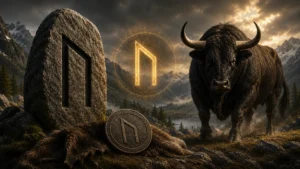
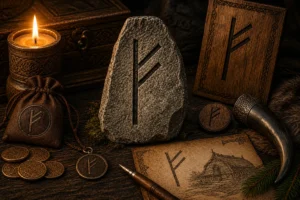
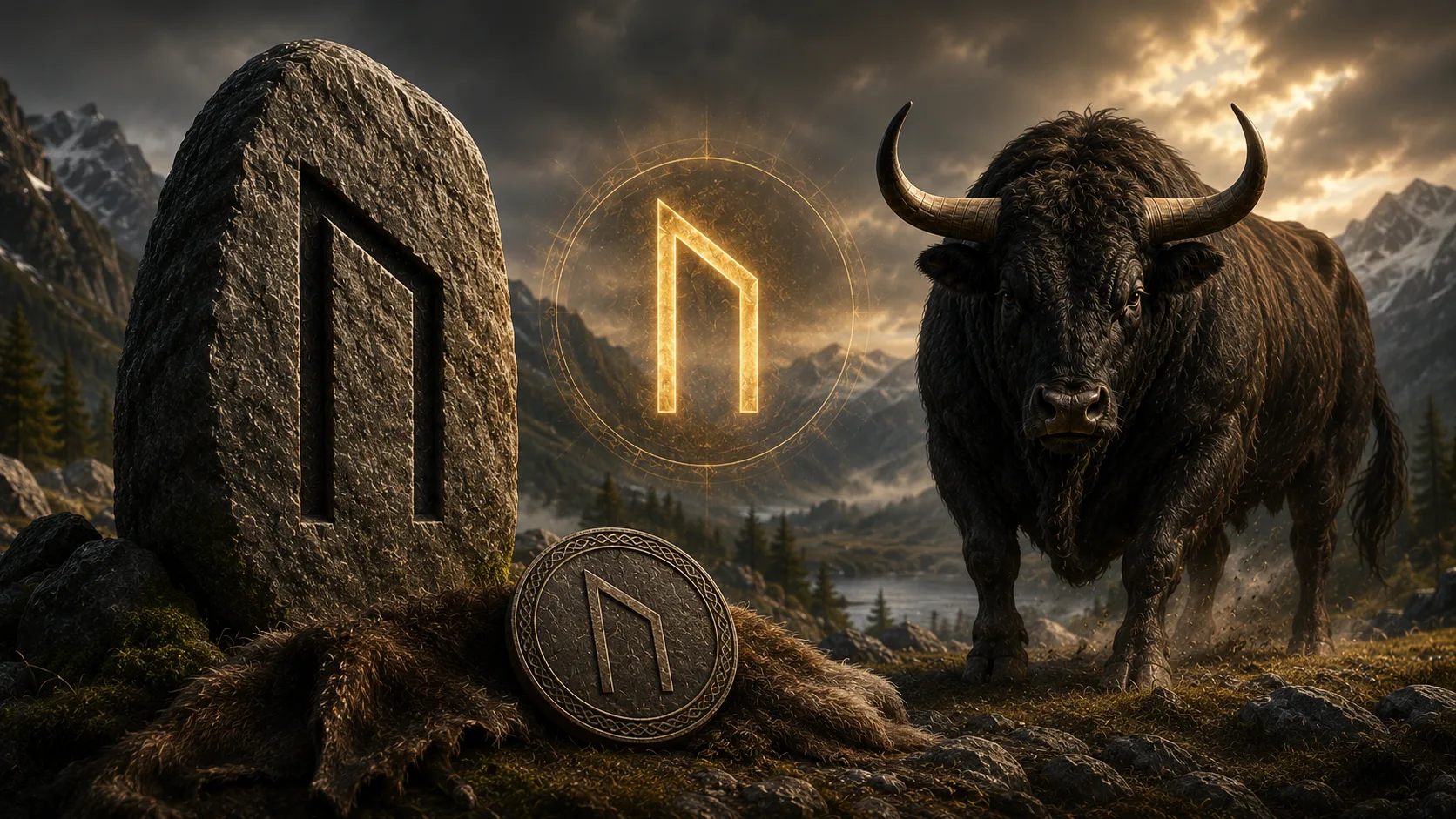
Fehu (ᚠ) is the very first rune of the Elder Futhark, the oldest runic alphabet we know of. Its name comes from the reconstructed Proto-Germanic word fehu, meaning “cattle” or “livestock.” That might not sound particularly grand until you understand what cattle meant to the people who created this symbol. In the early Germanic world, cattle were not just animals. They were currency. They were status. They were the difference between survival and starvation.
The fehu rune meaning is wealth. But not the kind that sits in a vault gathering dust. Fehu represents wealth that moves, grows, multiplies, and demands effort to maintain. It is the first rune for a reason. Everything else in the runic journey builds on the foundation that Fehu establishes.
The Etymology Behind Fehu
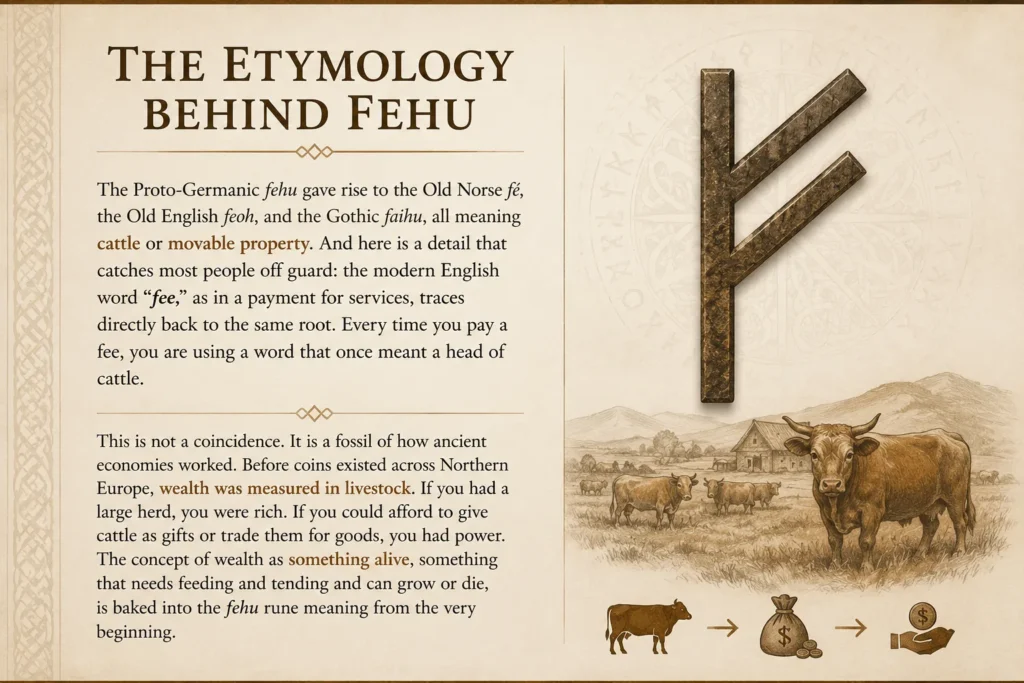
The Proto-Germanic fehu gave rise to the Old Norse fé, the Old English feoh, and the Gothic faihu, all meaning cattle or movable property. And here is a detail that catches most people off guard: the modern English word “fee,” as in a payment for services, traces directly back to the same root. Every time you pay a fee, you are using a word that once meant a head of cattle.
This is not a coincidence. It is a fossil of how ancient economies worked. Before coins existed across Northern Europe, wealth was measured in livestock. If you had a large herd, you were rich. If you could afford to give cattle as gifts or trade them for goods, you had power. The concept of wealth as something alive, something that needs feeding and tending and can grow or die, is baked into the fehu rune meaning from the very beginning.
What the Rune Poems Say About Fehu
Fehu is one of the few runes that appears in all three surviving medieval rune poems, and remarkably, all three agree on its core meaning: wealth. Where they disagree is on what wealth actually does to people.
The Norwegian Rune Poem, preserved in a 17th century copy of a lost 13th century manuscript, is blunt. It says that wealth is a source of discord among kinsmen, and then adds that the wolf lives in the forest. That second line is not random. Scholars interpret it as a warning: while you are fighting over money with your family, real danger lurks outside, ignored.
The Icelandic Rune Poem echoes the same warning, calling wealth “a source of discord among kinsmen and fire of the sea and path of the serpent.” The “fire of the sea” is a kenning for gold, since gold was imagined to gleam beneath the waves like fire. The “path of the serpent” likely refers to the mythological dragon Fafnir, who hoarded gold so obsessively that he transformed into a serpent to guard it. The message is clear: wealth can consume you.
The Anglo-Saxon Rune Poem takes a different, more Christian angle. It says that wealth is a comfort to all people, but adds that every person must share it freely if they wish to earn honour in the sight of the Lord. The Christian overlay is obvious, but the underlying Germanic principle remains: wealth unshared is wealth wasted.
All three poems paint the same picture from different angles. Fehu is good. Fehu is necessary. But Fehu is also dangerous if mishandled.
Fehu’s Place in the Elder Futhark
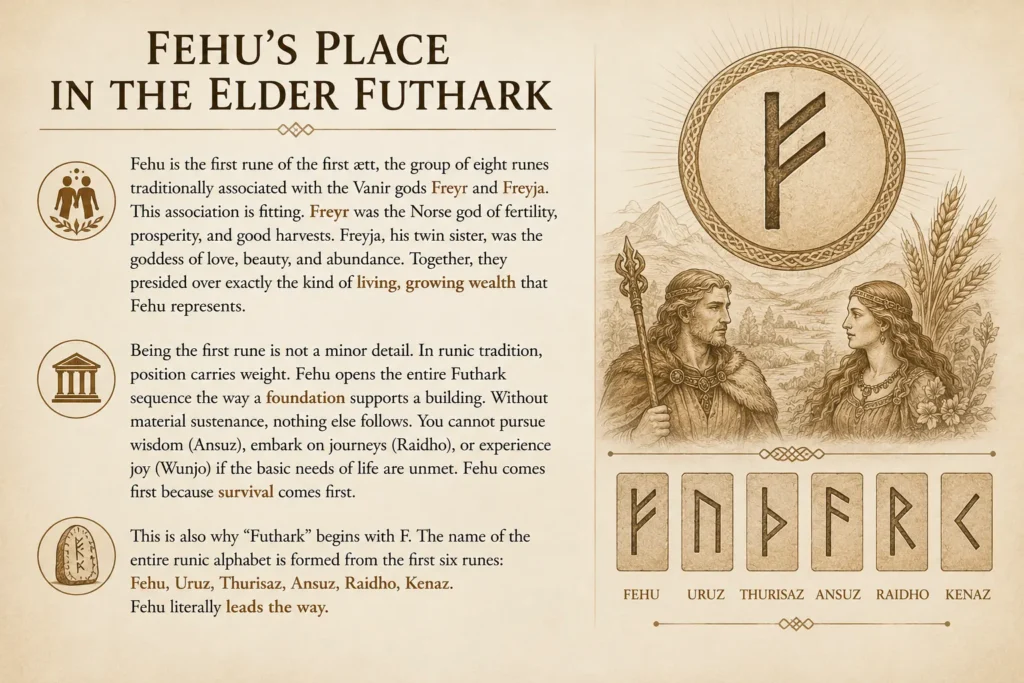
Fehu is the first rune of the first ætt, the group of eight runes traditionally associated with the Vanir gods Freyr and Freyja. This association is fitting. Freyr was the Norse god of fertility, prosperity, and good harvests. Freyja, his twin sister, was the goddess of love, beauty, and abundance. Together, they presided over exactly the kind of living, growing wealth that Fehu represents.
Being the first rune is not a minor detail. In runic tradition, position carries weight. Fehu opens the entire Futhark sequence the way a foundation supports a building. Without material sustenance, nothing else follows. You cannot pursue wisdom (Ansuz), embark on journeys (Raidho), or experience joy (Wunjo) if the basic needs of life are unmet. Fehu comes first because survival comes first.
This is also why “Futhark” begins with F. The name of the entire runic alphabet is formed from the first six runes: Fehu, Uruz, Thurisaz, Ansuz, Raidho, Kenaz. Fehu literally leads the way.
The Mythological Connection: Audhumla
There is a deeper mythological layer to the fehu rune meaning that most guides overlook.
In the Norse creation myth, the very first beings to emerge from the primordial void were the giant Ymir and a cow named Audhumla. Audhumla nourished Ymir with her milk and then licked the salty ice around her, gradually revealing the form of Búri, the first of the gods. Without Audhumla, there would be no gods, no worlds, no anything.
The connection to Fehu is hard to miss. The rune means cattle. The first cow in all of existence literally brought the gods into being through nourishment. Fehu is not just about owning things. At its deepest level, it is about the nourishing force that makes life possible in the first place.
The Shape of the Rune
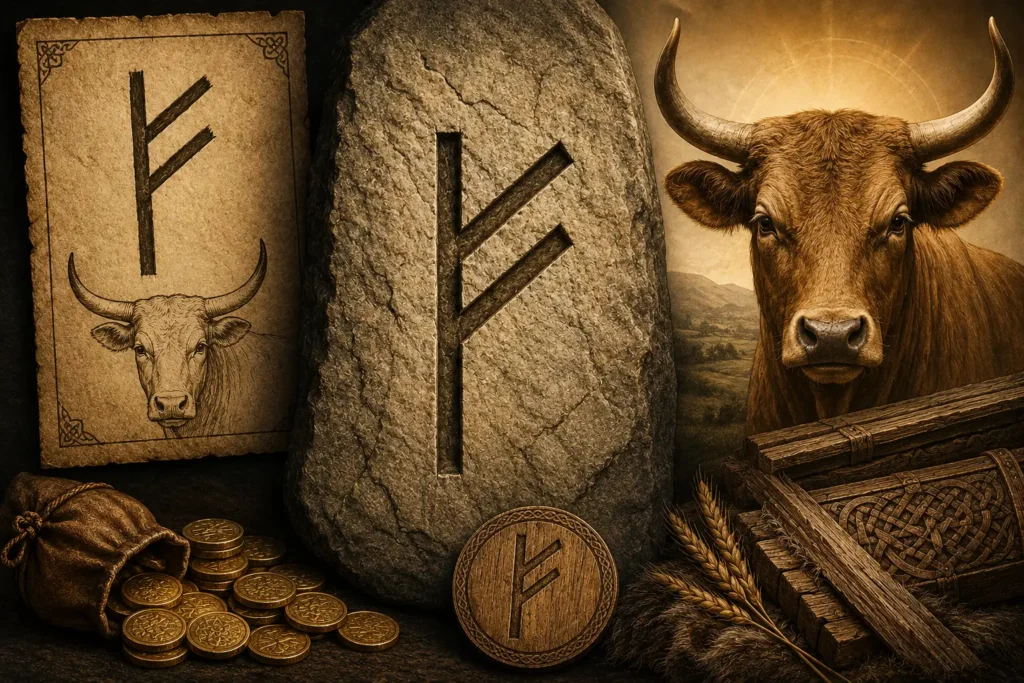
Look at the Fehu symbol (ᚠ) and you will notice two diagonal lines branching upward from a vertical stave, like horns on an animal’s head. Several scholars have noted the visual resemblance to cattle horns, and while this could be coincidental, it fits the pattern of runic design where the form often echoes the meaning.
Like all Elder Futhark runes, Fehu uses only vertical and diagonal lines, with no horizontal or curved strokes. This was a practical choice. Runes were originally carved into wood, and horizontal cuts would follow the grain and split the material. The angular design of Fehu, like every other rune, reflects the reality of the medium it was carved into.
Fehu as Mobile Wealth
One of the most important nuances of the fehu rune meaning is the distinction between mobile and fixed wealth. Fehu specifically represents movable property. Cattle, gold, trade goods, anything that flows and circulates. The final rune of the Elder Futhark, Othala (ᛟ), represents the opposite: inherited land, ancestral property, the kind of wealth that stays rooted in one place.
This distinction matters because it reveals how the Germanic peoples thought about different types of prosperity. Fehu is dynamic. It moves. It multiplies when managed well and disappears when neglected. Othala is static, inherited, bound to family and place. The Elder Futhark opens with one kind of wealth and closes with the other, framing the entire runic journey between them.
In a modern context, Fehu would be your income, your investments, your cash flow. Othala would be your family home, your inherited assets, your roots. Both are valuable. But Fehu is the one you build yourself.
Common Interpretations in Modern Rune Reading
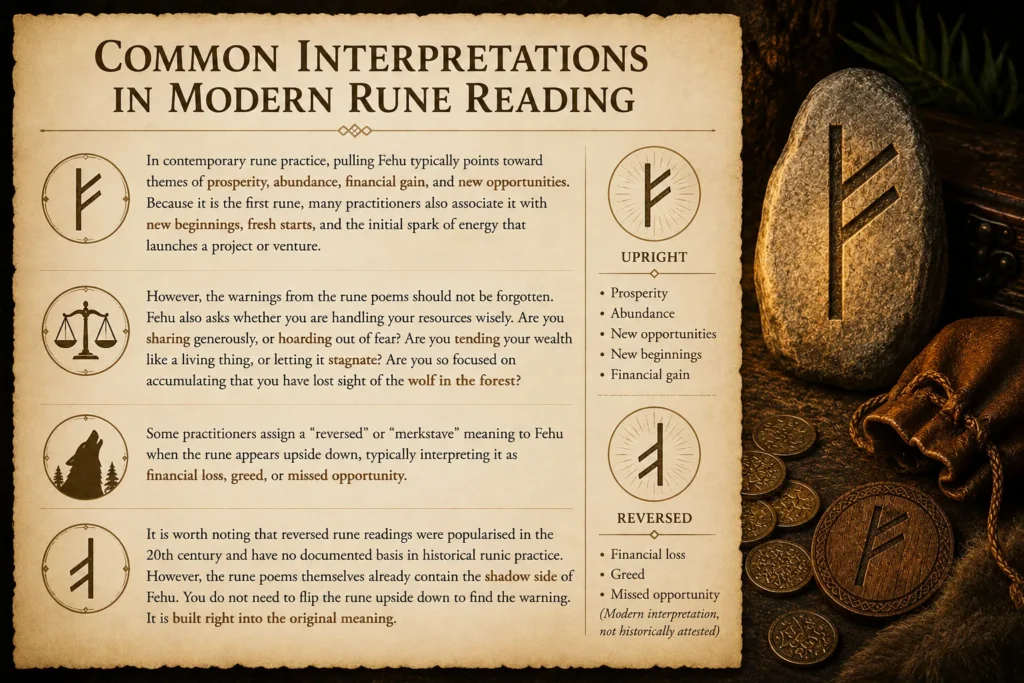
In contemporary rune practice, pulling Fehu typically points toward themes of prosperity, abundance, financial gain, and new opportunities. Because it is the first rune, many practitioners also associate it with new beginnings, fresh starts, and the initial spark of energy that launches a project or venture.
However, the warnings from the rune poems should not be forgotten. Fehu also asks whether you are handling your resources wisely. Are you sharing generously, or hoarding out of fear? Are you tending your wealth like a living thing, or letting it stagnate? Are you so focused on accumulating that you have lost sight of the wolf in the forest?
Some practitioners assign a “reversed” or “merkstave” meaning to Fehu when the rune appears upside down, typically interpreting it as financial loss, greed, or missed opportunity. It is worth noting that reversed rune readings were popularised in the 20th century and have no documented basis in historical runic practice. However, the rune poems themselves already contain the shadow side of Fehu. You do not need to flip the rune upside down to find the warning. It is built right into the original meaning.
Fehu in Bind Runes
Because of its strong association with prosperity and positive energy, Fehu is one of the most popular runes used in bind rune combinations. Practitioners frequently pair Fehu with Jera (ᛃ, the harvest rune) for sustained growth, with Sowilo (ᛊ, the sun rune) for vitality and success, or with Wunjo (ᚹ, the joy rune) for abundance that brings genuine happiness rather than empty accumulation.
What Fehu Teaches
Stripped down to its essence, Fehu teaches a remarkably practical lesson. Wealth is good. Wealth is necessary. But wealth is alive. It needs to flow, it needs to be shared, and it needs constant attention. Hoard it, and it turns poisonous. Neglect it, and it vanishes. Use it wisely, generously, and with awareness of its power, and it becomes the foundation on which everything else is built.
That is why it is the first rune. Not because the Norse were materialistic. But because they were practical enough to know that nothing grows without a root in the ground and food on the table.