
Here is something most people do not know. Celtic runes, as a term, is technically a contradiction. The Celts did not use runes. Runes belonged to the Germanic and Norse peoples. What the Celts actually used was something entirely different, a writing system called Ogham that looks nothing like the angular characters of the runic world.
But the term “celtic runes” has stuck in popular culture, and there is a good reason for that. Ogham and runes served eerily similar purposes. Both were carved into stone. Both carried symbolic meaning beyond simple phonetics. Both were associated with gods, magic, and the educated elite. And both cultures even shared the same word for “secret,” with the Old Norse rún and the Irish rún carrying nearly identical meanings.
So whether you arrived here looking for actual runes or for the Celtic writing system that mirrors them, this guide covers both. Let us untangle the history, the symbols, and the real meanings behind what people call celtic runes.
Ogham: The Real Celtic Writing System
Ogham (pronounced OH-am) is the oldest known writing system of the Irish language. It dates from roughly the 4th to the 10th century CE, though some scholars at Maynooth University believe the script itself may have developed earlier, with the earliest stone inscriptions appearing between the 4th and 7th centuries.
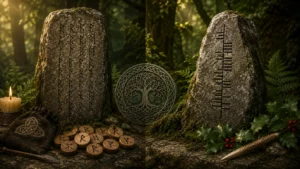
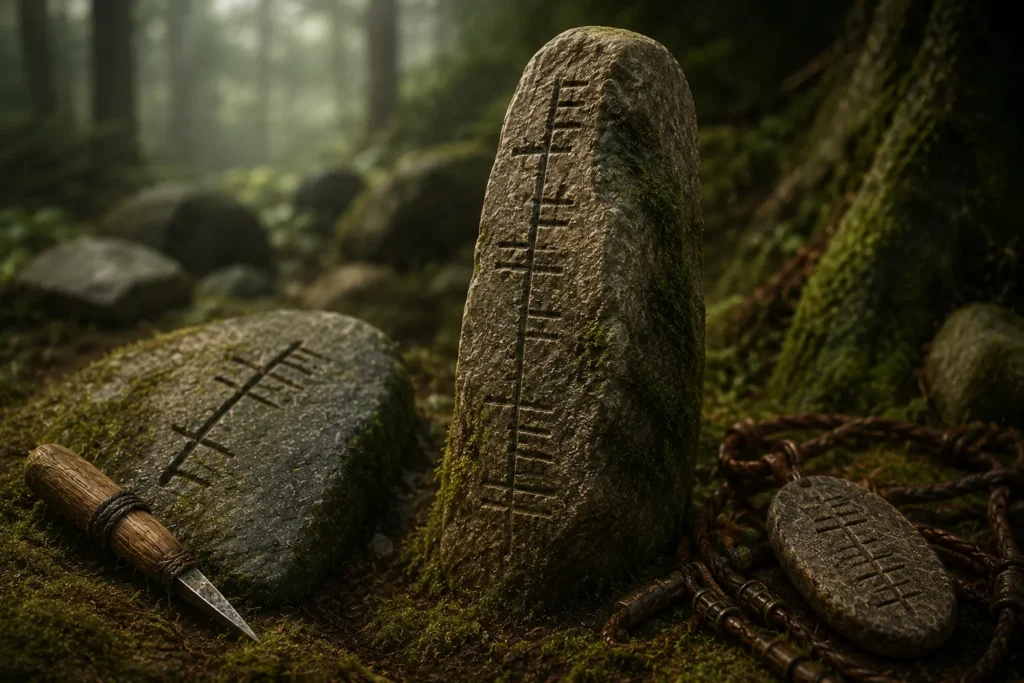
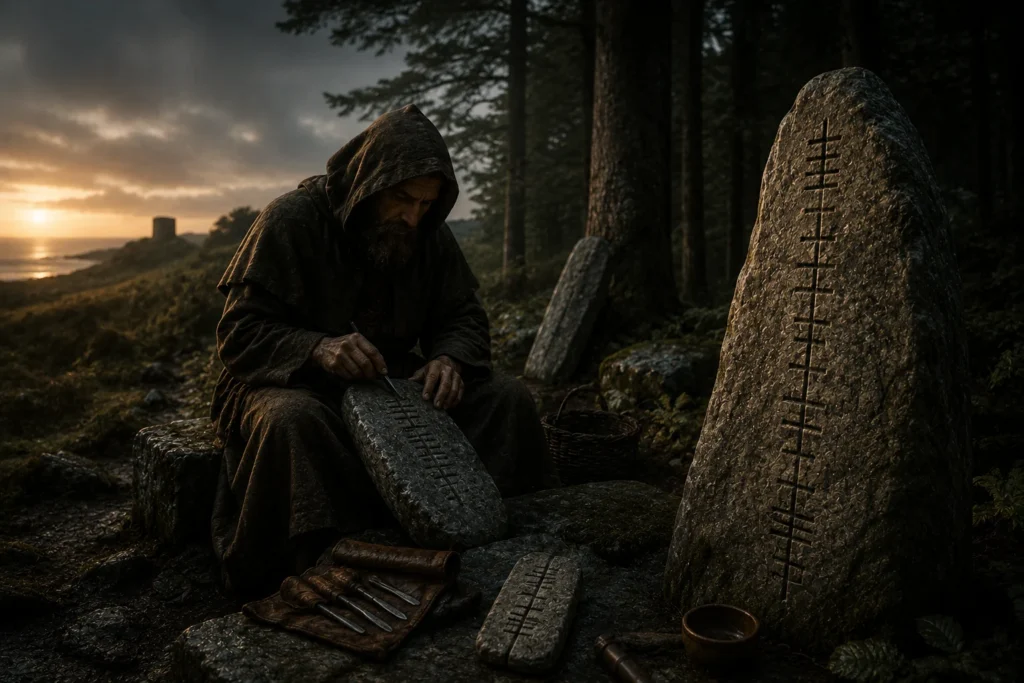
Unlike runic alphabets that use angular characters, Ogham is built from clusters of straight lines, one to five strokes scratched along or across a central vertical line. On standing stones, that central line is usually the sharp edge of the stone itself. The strokes branch off to the left, to the right, or cut diagonally across, depending on which letter they represent.
The inscriptions read from bottom to top, climbing the stone like, as one medieval Irish text puts it, “a tree is climbed.” It is a beautifully simple system. And yet behind that simplicity sits a surprisingly complex cultural tradition.
Over 400 Ogham stones survive today, according to Maynooth University’s research. Roughly 360 of those are in Ireland, concentrated heavily in the southwest counties of Kerry, Cork, and Waterford. The rest are scattered across Wales, Scotland, the Isle of Man, and Devon. The largest outdoor collection on public display is the Stone Corridor at University College Cork, which houses 27 inscribed standing stones.
Who Invented Ogham?
Like the Norse with their runes and Odin, the Celts attributed their writing system to a god.
The Book of Ballymote, a medieval Irish manuscript compiled in 1390 and 1391, credits the invention of Ogham to Ogma, the Celtic god of eloquence and literature. Ogma was a member of the Tuatha Dé Danann, the mythological race of gods in Irish tradition. According to the Ogam Tract, Ogma created the alphabet specifically for the learned class, deliberately excluding “rustics and fools.”
The 7th century Auraicept na n-Éces (The Scholars’ Primer) records a different origin entirely, claiming that Ogham was invented shortly after the fall of the Tower of Babel. Both stories carry the same underlying message: writing was sacred, powerful, and not meant for everyone.
The scholarly consensus is that Ogham was most likely influenced by the Latin alphabet through early contact with the Roman world. The World History Encyclopedia notes that the script may have been designed partly as a way to write the Irish language in a form distinct from Latin, possibly even as a deliberate act of cultural identity.
The parallel to Norse mythology is hard to ignore. Odin suffered on Yggdrasil for nine nights to seize the runes. Ogma, the honey-mouthed god of speech, carved the first Ogham staves through divine craft. Both cultures treated their writing systems not as human inventions but as gifts from the gods.
How Ogham Is Structured
The original Ogham alphabet contains 20 letters, divided into four groups of five called aicme (plural aicmí), an Irish word meaning “family” or “group.” This mirrors the ættir structure of the Elder Futhark, which also divides its 24 runes into groups of eight.
A fifth group of five additional letters, called the forfeda, was added later, probably around the 6th century, to accommodate changes in the Irish language. This brought the total to 25 characters.
Each of the four original groups uses a different visual pattern. The first group (Aicme Beithe) uses one to five horizontal strokes to the right of the stem line. The second group (Aicme hÚatha) uses strokes to the left. The third group (Aicme Muine) uses diagonal strokes across the line. The fourth group (Aicme Ailme) uses notches or short scores directly on the line, representing vowels.
The Tree Connection
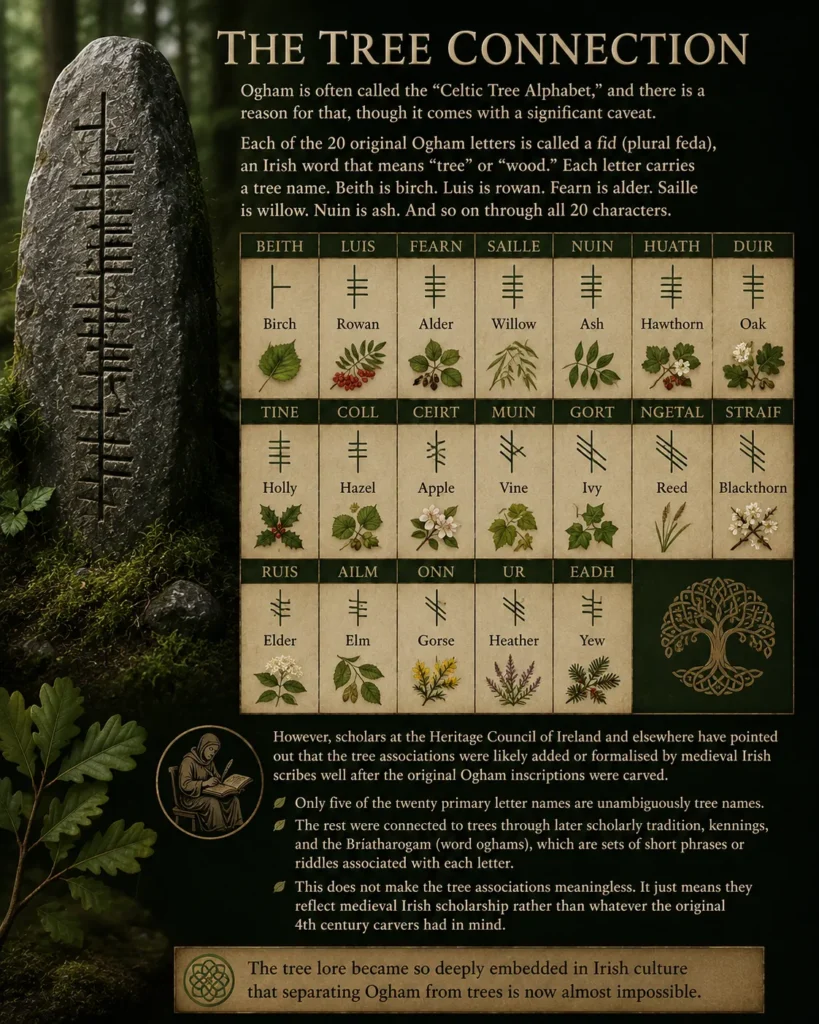
Ogham is often called the “Celtic Tree Alphabet,” and there is a reason for that, though it comes with a significant caveat.
Each of the 20 original Ogham letters is called a fid (plural feda), an Irish word that means “tree” or “wood.” Each letter carries a tree name. Beith is birch. Luis is rowan. Fearn is alder. Saille is willow. Nuin is ash. And so on through all 20 characters.
However, scholars at the Heritage Council of Ireland and elsewhere have pointed out that the tree associations were likely added or formalised by medieval Irish scribes well after the original Ogham inscriptions were carved. Only five of the twenty primary letter names are unambiguously tree names. The rest were connected to trees through later scholarly tradition, kennings, and the Bríatharogam (word oghams), which are sets of short phrases or riddles associated with each letter.
This does not make the tree associations meaningless. It just means they reflect medieval Irish scholarship rather than whatever the original 4th century carvers had in mind. The tree lore became so deeply embedded in Irish culture that separating Ogham from trees is now almost impossible.
The 20 Ogham Letters and Their Meanings
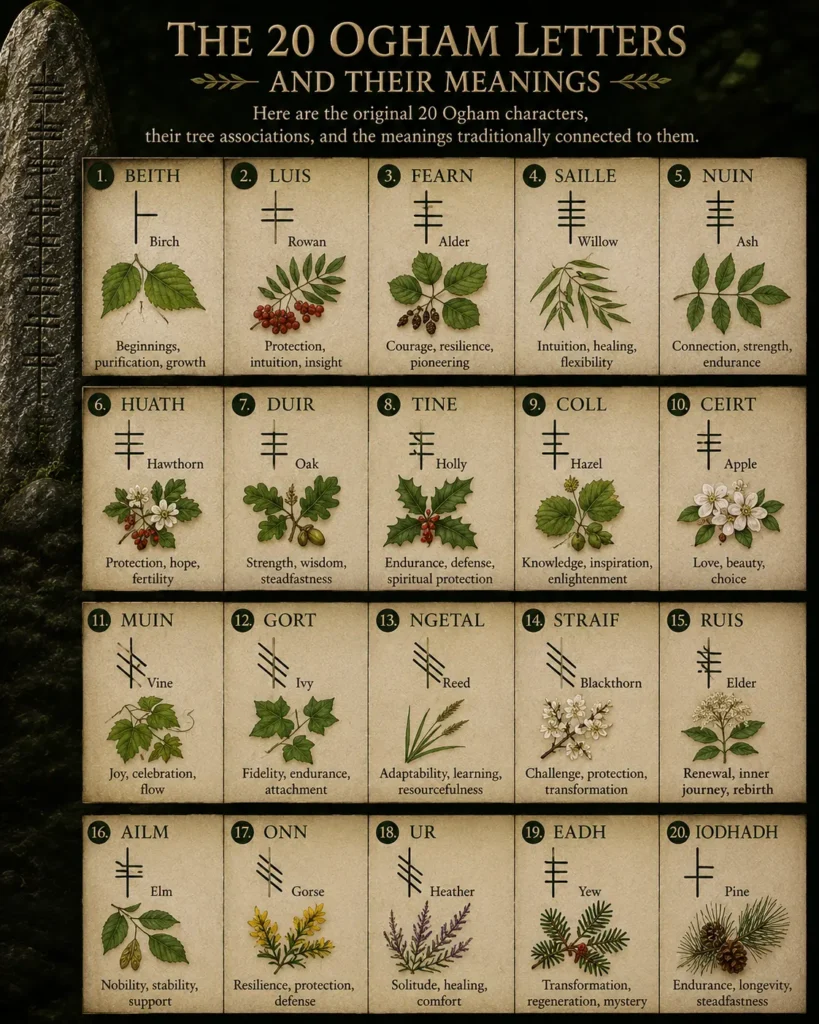
Here are the original 20 Ogham characters, their tree associations, and the meanings traditionally connected to them.
Aicme Beithe (B Group)
Beith (B) means birch. It symbolises new beginnings, purification, and renewal. The birch is one of the first trees to colonise cleared ground.
Luis (L) means rowan. It represents protection, intuition, and clear vision. Rowan was widely believed in Irish folklore to ward off enchantment.
Fearn (F) means alder. It symbolises courage, strength in adversity, and resilience. Alder wood resists water and was used for building foundations and shields.
Saille (S) means willow. It represents intuition, flexibility, and emotional balance. The willow bends without breaking.
Nuin (N) means ash. It symbolises connection, transformation, and the linking of inner and outer worlds. The ash tree held deep significance across both Celtic and Norse traditions.
Aicme hÚatha (H Group)
Úath (H) means hawthorn. It represents challenge, testing, and cleansing. The hawthorn was considered a boundary tree between the ordinary world and the otherworld.
Duir (D) means oak. It symbolises strength, endurance, and solid foundations. The oak was the most sacred tree in Celtic tradition, and the word “druid” may derive from a root meaning “oak-knower.”
Tinne (T) means holly. It represents balance, directed energy, and the warrior spirit. Holly stays green through winter, making it a symbol of persistence.
Coll (C) means hazel. It symbolises wisdom, creativity, and inspired knowledge. In Irish mythology, the Salmon of Wisdom gained its knowledge by eating hazelnuts that fell into a sacred pool.
Quert (Q) means apple. It represents beauty, choice, healing, and the otherworld. Avalon, the mythical island, takes its name from a word for apple.
Aicme Muine (M Group)
Muin (M) means vine. It symbolises prophecy, inner development, and the release of inhibition.
Gort (G) means ivy. It represents perseverance, the search for self, and growth that finds a way through any obstacle.
nGéadal (NG) means broom or reed. It symbolises healing, direct action, and transformation.
Straif (ST) means blackthorn. It represents discipline, unavoidable change, and the challenge that strengthens you.
Ruis (R) means elder. It symbolises endings that create space for new beginnings, maturity, and the wisdom that comes with age.
Aicme Ailme (Vowel Group)
Ailm (A) means fir or pine. It represents clarity, vision, and the ability to see far ahead. Fir trees grow straight and tall above the forest canopy.
Onn (O) means gorse or furze. It symbolises gathering, attraction, and the golden warmth of spring. Gorse flowers almost year round in Ireland.
Úr (U) means heather. It represents generosity, community, and the healing of the land.
Eadhadh (E) means aspen. It symbolises endurance, the passing of fear, and the courage to face what shakes you. Aspen leaves tremble in the slightest wind but the tree itself stands firm.
Iodhadh (I) means yew. It represents death, rebirth, and transformation across lifetimes. The yew appears in both Celtic and Norse traditions as a tree that bridges the worlds of the living and the dead.
How Celtic Runes Differ from Norse Runes
People search for “celtic runes” because the two traditions genuinely share common ground. Both were carved into stone. Both were associated with sacred knowledge. Both used tree symbolism. And the word rún appears in both Old Norse and Irish with nearly identical meanings of “secret” or “mystery.”
But the differences are substantial. Norse runes are angular characters derived from Old Italic alphabets, designed for carving into wood and later stone. Ogham uses clusters of straight lines along a stem, designed for carving along the edges of standing stones. Norse runes were used across a vast geographic range, from Scandinavia to Constantinople. Ogham was concentrated in Ireland and the Celtic fringe of western Britain.
Functionally, most surviving Ogham inscriptions are short and formulaic, typically reading “X son of Y” and serving as memorials or territorial markers. Viking rune inscriptions covered a wider range of uses, from memorial stones and weapon labels to magical charms and casual graffiti.
The two systems are siblings from different families. Related in spirit, completely separate in origin.
Why Celtic Runes Still Fascinate People
The appeal of Ogham in the modern world mirrors the appeal of Norse runes. Both systems offer a connection to ancestral cultures that valued the natural world, honoured their dead with carved stone, and believed that language itself held power.
Today, Ogham is used in jewellery, tattoos, and neo-pagan spiritual practices, much like the Elder Futhark. Ireland’s Heritage Council actively promotes Ogham awareness, and the Ogham in 3D project at the Dublin Institute for Advanced Studies has been digitising surviving stones using laser scanning technology, making them accessible to researchers and enthusiasts worldwide.
Whether you call them celtic runes or Ogham, these symbols are a direct line to a culture that carved names into stone so that they would never be forgotten. Fifteen centuries later, those names are still being read.